


Artifact #1
New Infrastructure?
Where to go?
Speculative
Futures
Overview
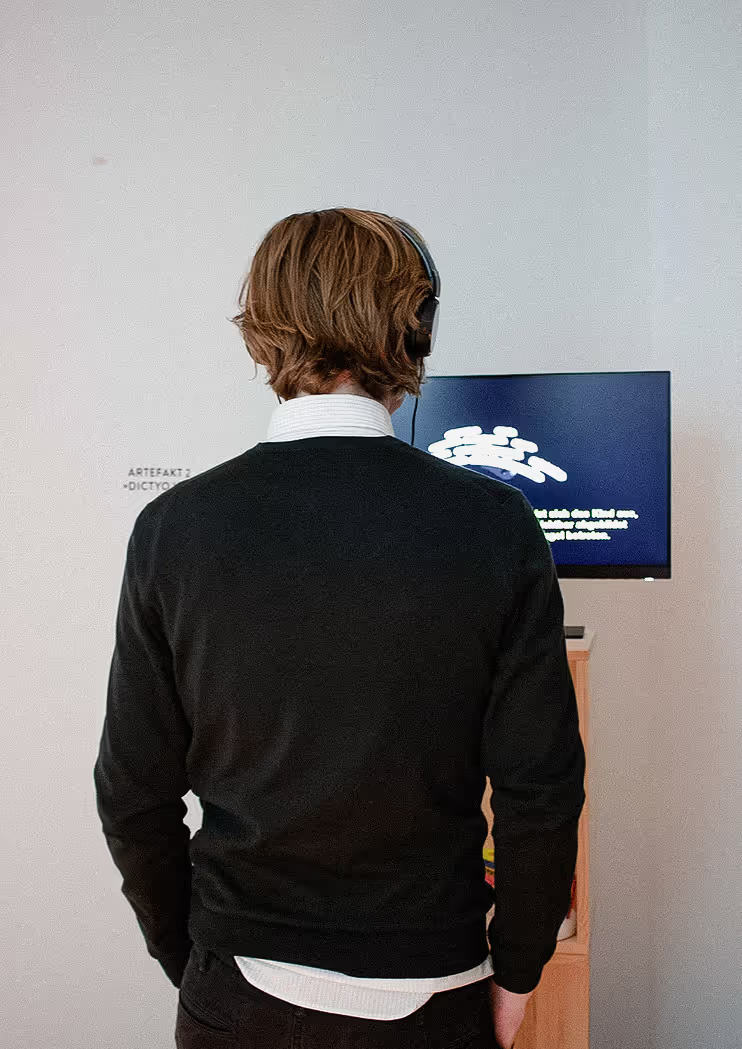
Because we prefer to experience and understand new things ourselves rather than just talk about them, we regularly engage with relevant trends and future concepts. Under the headline "Where to go?", we explore speculative futures of autonomous mobility.
Speculative design
and artifacts of the future
Speculative design is an experimental design approach used to sketch out alternative futures. These future scenarios are grounded in research, emerging technologies, or societal developments. The futures that emerge from this work are uncertain, and speculative design addresses that uncertainty with "future artifacts" that spark and provoke discussion. In doing so, they influence the decisions and debates of the present, which in turn shape the futures ahead of us.
Using the topic of "autonomous mobility" as an example, we explore how suitable this design approach is for our innovation work in Design Thinking, Futures Thinking, and User Research. In collaboration with designers, we develop future artifacts that highlight aspects of »autonomous mobility« beyond the usual status quo debates and open them up for discussion. We then use these artifacts in a user‑research process, that helps us gain a deeper understanding of future user needs.
The result: through a co‑creative process, we reflect on, develop, and shape desirable futures together with organizations and their users.
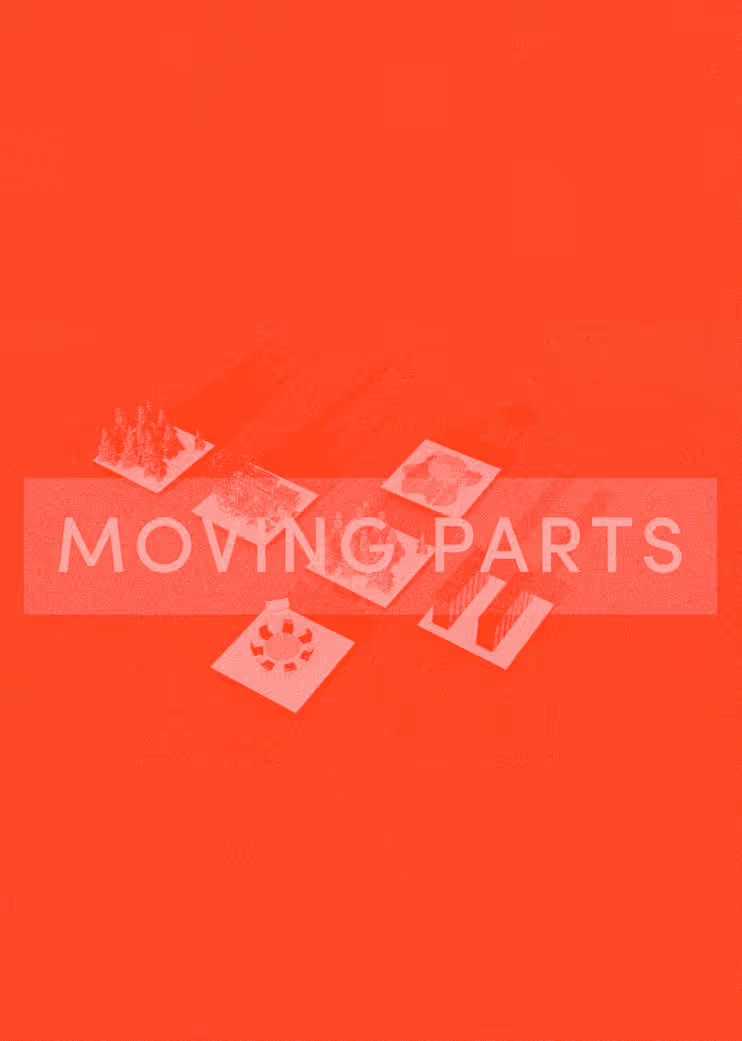
Moving Parts – Infrastructure of a City of Tomorrow
Our first speculative artifact was created in collaboration with Bernd Hopfengärtner. With "Moving Parts", he sketches a future scenario that questions an entire city’s infrastructure and rebuilds it from scratch. "Moving Parts" imagines a future in which the relationship between space and time is redefined, creating an everyday life governed by entirely new principles.
The ultimate goal of autonomous driving is the end of "being on the way": travel time should be as short as possible – and ideally no longer perceived as travel time at all. The most radical version of this idea appears in concept studies developed by Toyota together with the design firm IDEO: self‑driving room modules – from offices to kung‑fu studios – entire spaces of daily life and work become mobile. In this vision, the seemingly unavoidable link between time and space dissolves, because movement through space is replaced by movement within space. The journey becomes the destination, because the destination is already present along the way.
This is the logisticians’ dream. A forward‑looking Amazon patent, for example, enables goods to be delivered to locations where demand is statistically expected to peak – meaning that when an order is placed, the item is already almost at its destination. Our thought experiment combines these two ideas into a future scenario in which cities become fully mobilized – every element of the city is constantly in motion, continuously shifting its position to be wherever it best meets residents’ needs at any given moment.
This raises a central question: What would life in such a city look like? Our project aims to explore precisely these questions about the future of autonomous mobility.
See video documentation.
Artifact #2
New ways home?
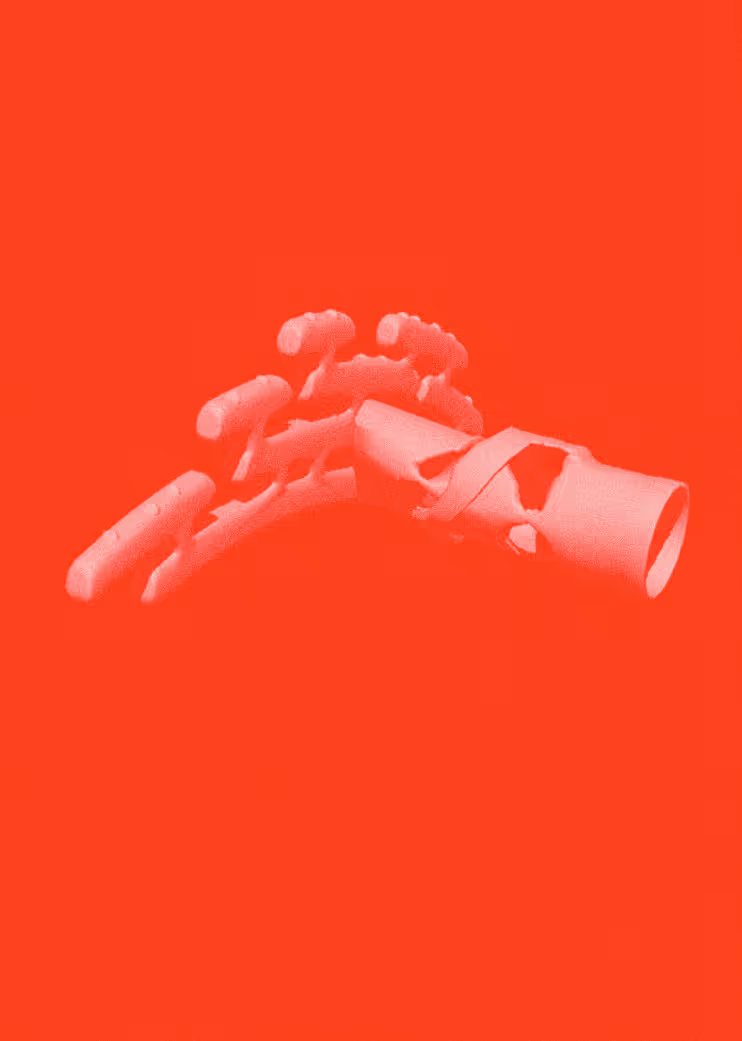
Dictyo Home – a speculative design artifact
Our second artifact, "Dictyo Home", builds on the world outlined in the first artifact, "Moving Parts", in which cities are fully autonomously mobilized. Derived from the reactions gathered in the initial user research, "Dictyo Home" addresses the question of how children can find their way home in a city that is constantly in motion.
This second artifact describes a system designed to ensure a safe journey home for children. Conceptually, it draws inspiration from the functioning of human cells. The dictyosome is a cellular organelle that manages the transport of substances within the cell by releasing membrane‑enclosed vesicles and directing them to specific regions. If we imagine the mobilized city itself as a cell, this system can be adapted. Using their own dictyosome structure, children can enter the vesicle‑vehicles, which then autonomously transport them home. Their own cellular physiology becomes both the key and the ticket.
The "Dictyo Home" artifact thus offers a response to the question of how children might navigate their way home in a perpetually moving city. At the same time, it reveals a tension between safety and isolation. Can mobility feel unnatural when it is based on a biological concept?

Artifact #3
New senses?
Next Senses – Magnetizer & Sniffer
After the first future scenario, "Moving Parts", which depicts a city in constant reconfiguration, our user research in the speculative design and future foresight project "Where to go?" led us to the artifact "Dictio Home". "Dictio Home" offers an answer to the question of how children can find their way home in a city that is permanently in motion. In doing so, two opposing poles emerged: safety and isolation. In our second round of user research, we therefore asked participants whether mobility could feel unnatural when it is based on a biological concept. The responses showed that the discussion focused less on safety and more on the child’s psychological state. Children (and adults alike) lacked a sense of orientation. Most participants reported feeling confused in a city that constantly reconfigures itself. Handing over control to an »autonomous machine« often created a sense of unease.
To explore these thoughts further, our third artifact centered on the question: How can we maintain or regain a sense of orientation and control in an automated, technologized environment? Technologies drastically reshape our surroundings, yet the capabilities of our bodily perception remain the same. Our senses connect us to people, emotions, and the world around us – they fundamentally shape our well‑being. For this reason, the third artifact focuses on reclaiming control and orientation in a world of autonomous mobility.
The two resulting artifacts explore the idea of extending human senses. What if we could perceive our environment on an entirely different level?
"Sniffer" is a speculative design object that fundamentally transforms human smell perception. With its specialized scent sensor, it allows us to amplify even the faintest smells and develop a sense of smell as powerful as that of animals such as dogs. It also enables us to select which scents we want to perceive. In addition, the Sniffer includes a kind of "memory function" that lets us use previously detected scents for orientation. We can follow the scent trail to our workplace or to a familiar or close person. We upgrade our senses for a new era and discover a new dimension of perception and orientation.
In the case of the "Magnetizer", a close‑fitting wearable signals magnetic north to the wearer through a subtle warmth impulse. A sense previously inaccessible to humans is now provided externally. Orientation becomes something one can physically feel.

You can find out how speculative design and fishing for tomorrow's needs can be applied in your own contexts in our brochure.
Download
Discover more
From current projects to selected case studies and inspiring methods. Explore how we work and the formats we use.
Interested?
Simply write us a message in the contact field. Or send us an email:
hallo@berliner-ideenlabor.deThank you! Your submission has been received!
Oops! Something went wrong while submitting the form.
Let’s Co-Create Futures
